


Founding Partner
Real estate has long served as a foundation of private wealth. It can generate income, appreciate over time, provide diversification, and support multigenerational planning. Yet many investors devote considerably more attention to acquiring property than to determining how and when they will eventually exit it.
That imbalance can become costly. Capital gains tax on real estate may affect the liquidity available after a sale, the timing of portfolio changes, and the relative value of holding, transferring, or disposing of a property. For high-net-worth individuals, the tax implications may also extend beyond the property itself, interacting with income planning, estate strategy, charitable giving, and the management of concentrated assets.
The central question is therefore broader than how much tax a sale may generate. Investors must consider whether an appreciated property remains the best use of capital after accounting for taxes, risk, liquidity, and long-term family objectives.
How Capital Gains Tax Applies to Real Estate
A taxable gain generally arises when a property is sold for more than its adjusted cost basis, which may reflect the purchase price, qualifying improvements, depreciation, and certain transaction costs.
For a principal residence, qualifying homeowners may exclude up to $250,000 of gain, or $500,000 for married couples filing jointly, if applicable ownership and use requirements are met. Any remaining long-term gain may be taxed at federal rates of 0%, 15%, or 20%, depending on taxable income. Higher-income taxpayers may also owe the 3.8% Net Investment Income Tax.
The chart below shows the 2026 federal long-term capital gains thresholds by filing status.
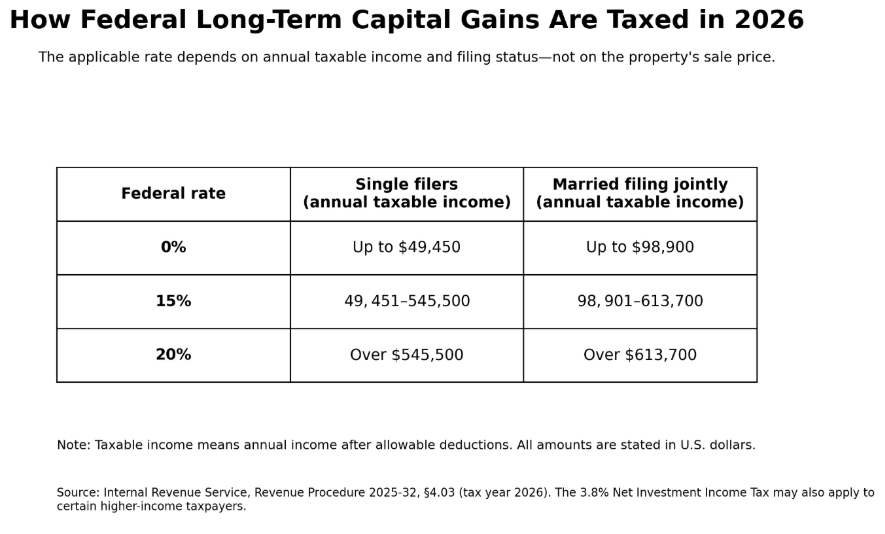
For certain higher-income taxpayers, a 3.8% Net Investment Income Tax may also apply. Investment properties introduce additional complexity. They do not qualify for the principal-residence exclusion, and prior depreciation deductions may generate unrecaptured Section 1250 gain taxed at a maximum federal rate of 25%. State and local taxes may further affect the proceeds from a sale.
Why More Homeowners Are Exceeding the Exclusion
The principal-residence exclusion has remained at $250,000 for individuals and $500,000 for married couples since 1997, while home prices have increased substantially across many markets. Because these thresholds were never indexed to inflation, they now capture a growing number of long-term homeowners—particularly those in high-appreciation markets. For affluent households, the impact may be even greater, as primary residences, vacation homes, and investment properties often represent a substantial share of family wealth.
The Lock-In Effect
Capital gains tax can influence behavior long before a property is listed for sale. When owners anticipate a significant tax bill, they may postpone selling even when the property no longer meets their financial or lifestyle needs. Economists describe this as the lock-in effect. Business Insider has documented cases of older homeowners reluctant to downsize because a sale would generate substantial taxable gains. This illustrates how tax exposure can discourage an otherwise practical move from a large, appreciated residence to a smaller property.
Tax-Aware Planning Before a Sale
Capital gains planning is most effective when it begins well before a property is listed for sale. Once a transaction is underway, many planning opportunities may no longer be available. Consider the following strategies:
1. Maintain Accurate Basis Records
Keep thorough documentation of qualifying capital improvements, such as additions, major renovations, or new building systems, as these may increase a property’s adjusted cost basis. Routine repairs generally do not qualify. For properties held over many years, incomplete records can result in overstating taxable gains.
2. Coordinate the Sale With Other Income
Because long-term capital gains rates depend partly on taxable income, the timing of a sale can affect the tax outcome. A transaction should be evaluated alongside the investor’s broader income, deductions, and liquidity needs.
3. Review Ownership and Use History
Changes in a property’s use—such as converting a primary residence into a rental—can affect eligibility for the home-sale exclusion, depreciation treatment, and the calculation of taxable gains. These implications should be evaluated before making the change.
4. Consider a Section 1031 Exchange
A properly structured Section 1031 exchange may allow investors to defer capital gains taxes when exchanging qualifying investment or business real estate. While this strategy can preserve capital for reinvestment, it is subject to strict IRS rules and defers rather than eliminates the underlying tax liability.
Portfolio Construction and Liquidity
The correct tax decision is not always the decision that produces the lowest immediate tax bill. Holding an appreciated property may defer tax, but it may also preserve an undesirable concentration. Selling may generate tax, while allowing the investor to reduce risk, increase liquidity, or allocate capital toward assets with more attractive expected returns.
A tax-aware portfolio review should consider:
- The property’s after-tax income and expected appreciation
- Its proportion of total family wealth
- Geographic and sector concentration
- Debt structure and refinancing exposure
- Capital expenditure requirements
- The after-tax opportunities available elsewhere
- The family’s liquidity and estate-planning needs
This framework helps distinguish productive tax planning from tax avoidance that restricts sound investment decisions. The objective is to improve the family’s overall after-tax position while preserving flexibility.
Estate and Intergenerational Considerations
Highly appreciated real estate can play an important role in estate planning. Under current federal rules, property included in a decedent’s estate generally receives a basis adjustment to fair market value at death, which may reduce or eliminate embedded capital gains.
This creates a strategic choice. An owner may sell during life and use the proceeds for diversification, gifting, consumption, or new investments. Alternatively, the property may be retained for transfer at death, subject to estate-tax exposure, liquidity needs, management responsibilities, and the family’s willingness to continue owning it.
The step-up in basis should not be considered in isolation. Holding a property solely to avoid capital gains tax may leave the family with excessive concentration, operational burdens, or an asset heirs do not want. For philanthropic owners, donating appreciated property may also help address embedded gains, though valuation, debt, deduction, and prearranged-sale issues require careful review.